5.8.10

Play Me

by gringojenny


Picture this: a casual Sunday evening game of Scattergories – you’ve got 10 seconds left to think of 'Things found in the City of London'.

Blackberry: yes. Suit: yes. Piano…yes!

For the second year running, the City of London Festival began with an installation of 21 second-hand pianos all over London – from Hampstead Heath to St. Paul’s Cathedral. Each piano comes with a sight-specific song book including the likes of 'London Bridge is Falling Down', as well as the odd Beatles Medley thrown in for good measure.

The project aims to encourage social interaction and connection through music, and from my experiences, it does just that.

My first encounter with the street pianos came last year when I decided to tickle the old ivories myself on an otherwise dull Tuesday afternoon. After stumbling my way through a few precarious renditions of 'Yellow Submarine' and 'Humpty-Dumpty' I was approached by a sheepish looking tourist who requested I play 'Happy Birthday' for his girlfriend. Soon enough, we had the whole street involved, in was what was perhaps not the most tuneful version I have ever heard, but certainly the most enjoyable. Since then, my day is always made that much better whenever I spot complete strangers squeezed onto a piano stool, arguing over who gets to play the chorus of 'Hey Jude'.

Like public renditions of 'God Save the Queen' played on second-hand pianos, personal experiences are so much better shared, and I urge you to let me know about some of your experiences of the London street pianos, or indeed any similar musical encounter.


GringoJenny doing her part to improve her capital's ambience

(London, 2010)


1.8.10

Señor, be my twin?

by gringosam


Buxton is a quiet spa town in middle-England. The majority of British people would not be expected to place it on a map, but this peaceful countryside community is of importance due to its more prominent relatives. Buxton is, unknown to many, the British sister town of Quito – the Ecuadorian capital in which I am based.


At first glace, the two have very little in common. While the former is a tranquil haven for the British middle-class, the latter is a vibrant and crowded urban settlement tucked away in the Andes. Nevertheless, while they may be worlds apart in terms of culture and history, the two have more in common than first meets the eye. In relation to their respective countries, both are high-altitude market towns – although Quito’s impressive elevation of 2800m comfortably dwarves the 307m of Buxton!


Despite having a population seventy times smaller than that of it’s Latin American relative, Buxton comes with an impressive business repertoire of its own. Its thriving economy includes revenue derived from the commercialisation of the local spring waters, bottled and marketed by the Buxton Mineral Water Company. It is owned by confectionary giants Nestlé UK and has been the official mineral water of Wimbledon since 2001.


Michael Clement of the Buxton Tourist Information Centre declared that the local people of Buxton are 'very proud to be twinned with such a culturally vibrant city’. Buxton has been producing the same high-quality mineral water for over 5000 years, and Clement believes that the ‘common feature linking the two cities is one of a rich history’.


Our friend Michael could well be clutching at straws here though – I’ve never met anybody who is convinced by the logic behind the twinning of towns in this way. There are some bizarre examples out there: Gaza–Barcelona, Caracas–Reykjavik, Minsk–Nottingham and Hay-on-Wye–Timbuktu to name but a few. And I certainly wouldn’t have thought that Bishek, the capital of Kyrgyzstan (yes, Microsoft Word, I shall ‘Add to Dictionary’), would have much to offer to Canada’s most populous city, Toronto.


These non-relationships are quite unique in terms their subjects. Towns and cities are numb to their exotic twins, but imagine if the same concept was applied to humans. For every one of us fortunate enough to be paired with a Brazilian beach babe, there’d be three who landed themselves with a middle-aged Russian alcoholic called Sergei.


The twinning body, rather conveniently, is known by the acronym POINTLESS – Pick One Irrelevant Nation Then Locate Extravagant Sister Settlement. Having been critical of this set-up, I would say that my time in Quito has been wholly different on account of the city’s links with Buxton. Wait, no, it hasn’t. Perhaps in Buxton the Quiteño influence means you can now freely consume guinea-pig or call a white chap gringo as a matter of course? Somehow I doubt it.


The Shining: Freaky twins.

29.7.10

I Pledge Allegiance
by gringoluke

America is the centre of the world.

The above sentence will immediately tell you two things about me. First of all, despite my current residence in that so called Land of the Free, I'm still stubborn enough to keep spelling like an Englishman, and secondly, and perhaps more importantly, I'm enchanted enough by America for this to one day change.

It's difficult to find a person who doesn't have a romantic, enigmatic and bemused image of the most powerful nation on Earth. Ask anyone to draw a picture of what they think the average American looks like and they are probably going to hand you a sketch of an overweight redneck in a Hummer, automatic rifle in one hand and sun-glinting crucifix in the other. I guess that's fair. I take a huge amount of pleasure in asking people from other countries to describe the archetypal English person through the eyes of their own culture, and I'm always surprised with the wide variety of answers I get back.

(My German godparents tell me that English people are generally understood to be polite, calm and-- bizarrely—often red-headed. I guess they've never been to Magaluf.)

Everyone has their own general idea of what people from other nationalities will be like, but Americans appear to be in a league of their own. Granted, there are deviations within the country itself—we all know, of course, that California is full of iPad-toting yuppies and everyone in the South is a Republican—but for the most part, there is this general blanket of mystique that coats the entire country. Whether you think America is the land of opportunity or the land of broken dreams, you definitely think that it's something.


I grew up in America. A few months after my sixth birthday we moved from Southern England to a small town in Connecticut that was basically the backdrop for The Stepford Wives. In fact, it was the backdrop for The Stepford Wives as well as Revolutionary Road, which, if you've seen either of those two films that were filmed on location in my American hometown, will probably tell you a lot about the place where I grew up. My family, being English and therefore a little too round-pegged for square-hole suburbia, always teetered on the wispy edge of waspishness, never quite succumbing to the country clubs and Cape Cod summers that my classmates indulged in, but nevertheless planting ourselves into a comfortable New England lifestyle. Connecticut buried something in my DNA, a little nucleic egg that began to hatch many years after I left the states, at a time when I was looking at universities and my future. I knew that the latter lay in the US, but I was too intimidated by everything it stood for to even consider applying to an American college.

My parents have the same magnetism for America that I have. My father burst free from the dark winters and reluctant war of 1970s Britain and dragged my mother along to Detroit, Michigan, where the winters were even darker and war even more reluctant. The American spark took hold of them then and they've been coming back ever since. When my father finally retired last year, they arrived, shipwrecked and comatose by nearly forty years of travel, on the shores of Southern California. Filial piety and suntanned American girls meant I came too.

We've all been swept up in this tidal wave of American romanticism and, rationalise it as much as you like, that endless queue of curious emigrants, tourists and hopeful wannabes is not getting any shorter. Whether your mental image of this vast nation involves a white picket fence or a white hooded mask, you certainly have your own ideas about America. No matter where the currents of life drag you in the years to come, one thing is for certain: this country will cross your mind and probably your path at least once.

In the meantime, I'm going to keep spelling 'colourful' with that extra 'u' and calling London my capital. I don't think I'm ready for people to be drawing me as a fat evangelical redneck quite yet.


25.7.10

Morocco: A Photo Essay
by gringomeg

I feel for the Moroccans, having to put up with the downside of a booming tourism industry. But even more so, I feel for Moroccan camels that have to carry overweight German tourists across what must seem like an endless fragment of the Sahara. Don’t get me wrong; I am not one of those pretentious travelers who insists that the term ‘tourist’ and all activities associated with it is beneath them. No, no. I let a poor camel carry me over Saharan sand dunes, and I enjoyed every second of it. The eternal expanse of orange sand-waves was as breathtaking as good sex. But as I watched my overweight father wriggling around on his camel in front of me, I couldn’t help but feel a pang of guilt for the poor creature that was probably suffering from extreme exhaustion.

That was Morocco for me. Moments of beauty and awe, interspersed with bouts of guilt and frustration. In awe of the extraordinary mosaics adorning the walls of the majestic riads at which we stayed. Overwhelmed by the intricately woven streets of Fez’s medina that transformed my world into Agrabah, the fictional city of Aladdin. And frustrated that I was, indeed, a tourist. Like all the others, I had been convinced to buy more carpets than anyone could ever want or need.


21.7.10

¿Gringo…y Qué?
by gringosam


It’s mildly ironic that I find myself contributing to a blog entitled ¡Que Gringo! as I find myself burdened with the title on a daily basis. I am currently based in Ecuador’s capital city, Quito, and will continue to be until January. As a people, Ecuadorians are famous for their woven ponchos and colourful indigenous carnivals. They are not particularly known for an imposing physical stature or fair skin.


So imagine the looks as a pale 6’3” Yorkshire lad ducks under the doorway to take a seat at one of the city's many guinea-pig-serving restaurants. Everywhere a gringo goes in this country, there seems to be an eager, mobile audience. I’m a naturally shy character, so the audience of fifty when I stumble onto the bus in the morning can be discouraging. It’s part-and-parcel of life here though and a voice inside me tells me that the ego will take a hit when I return to the UK, where I barely stand out in a crowd of one.


Getting to the roots of the term gringo in South America has been occupying me for the past couple of weeks. I still can’t decide whether I find it offensive or not. While Ecuadorians will use it as something of a harmless term to denote the Western tourists that keep their economy ticking over, it is by the same token a very clear labelling of a particular race which would most likely be termed derogatory in my politically-correct homeland. The American Heritage Dictionary, for instance, classifies gringo as ‘offensive slang’, ‘usually disparaging’, and ‘often disparaging’. I know what you’re thinking: how pleasant!


But, perhaps surprisingly, my conclusion here is that these things ought to be taken with a pinch of salt. After all, in certain regions, a gringa is a ham-and-cheese-stuffed tortilla – so it’s more than possible that there’s been a terrible mix-up at my expense! If you refer to the Bios section of our blog, you will no doubt see in me a strong resemblance to my spicy gastronomic counterpart.


In the end though, it’s nothing more than a curious cultural experience and that’s what we want ¡Que Gringo! to be all about. I only hope that, over the months, I am able to serve up blog entries that are interesting and perhaps even entertaining. If for my part of the bargain I continue to eat defenceless domestic pets and endure weeks of unparalleled name-calling, I hope you can stick around for a while!


(Everything I post will be punctuated with my own photography, my ability in which far outweighs my written proficiency!)
Generation Impatient?
by gringokev

Every contemporary generation seems to be quietly – and often not so quietly - reviled by their intergenerational peers. The fact that ‘intergenerational’ is really a euphemism for parent-child relationships probably explains this phenomenon.

In the western world, the baby boomers complain about the loss of the idealised and progressive liberalism that they fought for, wasted by their lazy, sullen and materialistic kids. Similarly, Gen X – the wealthier and educated capitalists who grew up during the end of the Cold War - are now criticised for their cushy, middle-class, suburban lifestyles.

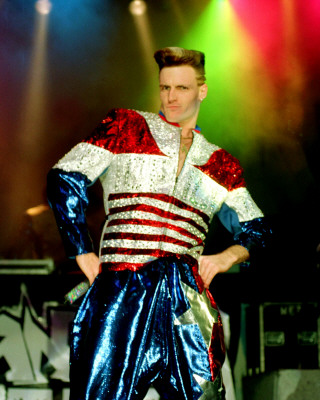
Gen Y – the generation of your beloved gringos - has a particular bone to pick with both pieces of bread in our generational sandwich. Gen X yuppies are responsible for Vanilla Ice, 80s fashion and rising rent prices in ‘grunge-chic’ student areas. Baby Boomers can take credit for the Iraq War and the Global Financial Crisis. An unfair comparison, Gen X? I will let you be the judge.

The next generation – who are likely to be labelled as the somewhat diminutive ‘noughties’ – is still in its twitter-happy infancy. Thus, in terms of sociological importance – and high-brow pub banter - Gen Y is coming of age. And not just in the American Pie kind of way.

We have reached the point where our generation will soon dominate that twenty to fifty year-old age bracket that stands at the helm. For the last couple of decades we have been sitting in the passenger seat, witnessing and having our lives shaped by the actions of our generational elders.

We will soon take the wheel.

But in 40 years, when we lie in our catatonic space beds, watching the millenials make love through touch screens and pray to the iGod, what will be our legacy?

I have meandered into this terrain in several recent conversations. What has resulted is not particularly pretty, or flattering. Apparently, we are lazy, self-obsessed, superficial half-wits who have lost the art of conversation and human contact. We are self-indulgent, unemotional and unwilling to work hard. We do not have an appreciation for skill, craftsmanship, learning or proper training. Most of all, we are impatient. We want everything here and now.

Before you smash the screen of your MacBook with your Gossip Girl Boxset, bear in mind that these conversations occurred mostly with other Gen Y-ites. Unlike generations before us, we seem to have recognised our faults. But in a world where we can get any information with the press of the button, could we really live any other way?

But will Wikipedia really be the highlight of our legacy? Wouldn’t we prefer to be known as the generation that fought climate change, that eradicated world poverty, that led peaceful governments, the generation-that-never-went-to-war?

An impossible task, you say? How are we going to begin to save the world?

Hang on, let me finish this Modern Family episode. Then we can start a facebook group and get crackin’.


The United Nations of Gaming
by gringoluke


Video games are the key to world peace.

Sure, a lot can be said for commodity-specific sanctions, for a new era of conciliatory diplomacy, for movements toward a nuclear-free world, but when it comes down to it I'm pretty sure that everyone would be better off if Obama and Ahmadinejad just bought an Xbox and played
Call of Duty all night.

I've had a love/hate relationship with video games ever since a young age. Like so many other boys growing up in an era when internet speed was still measured in kilobytes, I was brought up on a nutritious diet of
Mario Kart and 1080° Snowboarding. It was during those Nintendo 64 salad days that I learned of the powerful fraternity that video games have the power to culture between friends. While the sun beamed down outside on empty streets and sprinklers trickled unharrassed by leaping children, we sat in living rooms and grew blisters on our thumbs. Anybody who calls that a misspent youth obviously never played Goldeneye with three of their closest friends and an endless supply of pizza bagels.

The trick is to treat video games as a healthy, social experience. Sure, jogging is healthy and may give you clog-free arteries, but can you do it at 3 o'clock in the morning in your underwear while exchanging yo mama jokes with an 11 year-old from Amsterdam? There are some social experiences so bizarre that there's no way to experience them without a Playstation controller, wireless internet and— when playing online with those 11 year-olds—a particularly thick skin.

What I love most about video games is their ubiquity. Like
Family Guy quotes and Anchorman references, video games have become a universal code spoken and understood by swathes of young men throughout the Western world. I've seen perfect strangers fumbling along through awkward living room conversation one minute, then swearing enthusiastically at each other over a controversial Pro Evolution Soccer goal the next. Honestly, I think it's magical, and this is where Obama and the Axis of Evil could learn a lesson or two.

Alright, I'm not going to lie. Video games are not some sort of social instrument destined to pave the way to a brave new world. Addiction is a serious problem, and I think a lot of parents don't really realise it. It's become so serious that in April the South Korean government was
forced to ban online gaming after midnight. While spotty teenagers and video game execs will enthusiastically point to tests that suggest Grand Theft Auto will gradually grant you the hand-eye coordination of a neurosurgeon, we all know that you're more likely to end up with a headache and a guilty conscious for all the digital pedestrians you mowed down. Video games can be expensive, time-consuming and unhealthy. A little bit like heroin.

I'm not invincible myself, and sometimes as the hours drag by and the plastic from the controller starts to fuse into my skin I force myself to watch this video to give me the strength to hit that 'off' switch.


This is what your nine year-old is going to look like if you let him dabble too long in the nefarious art of video games. I know it looked like he smiled at the start but I'm pretty sure that was just a short-lived Xbox-induced high.

In the end though, if you can pace yourself then video games really can be a lot of harmless fun, and with the gaming industry now considered worth a staggering USD$22 billion it's fairly likely they'll be around to stay for a lot longer.

Whether or not President Obama plans to adopt them in his latest attempts to stop Iran from going nuclear is still undecided, but I wouldn't be surprised. Just be careful next time you take a shot at 'BIN_LADEN_SUX_44'. I don't expect the secret-service would appreciate you pwning their president.


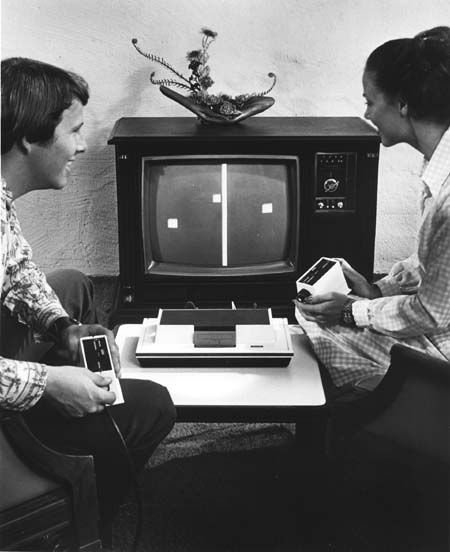
Photo credit: http://blog.tmcnet.com/blog/tom-keating/images/pong.jpg